
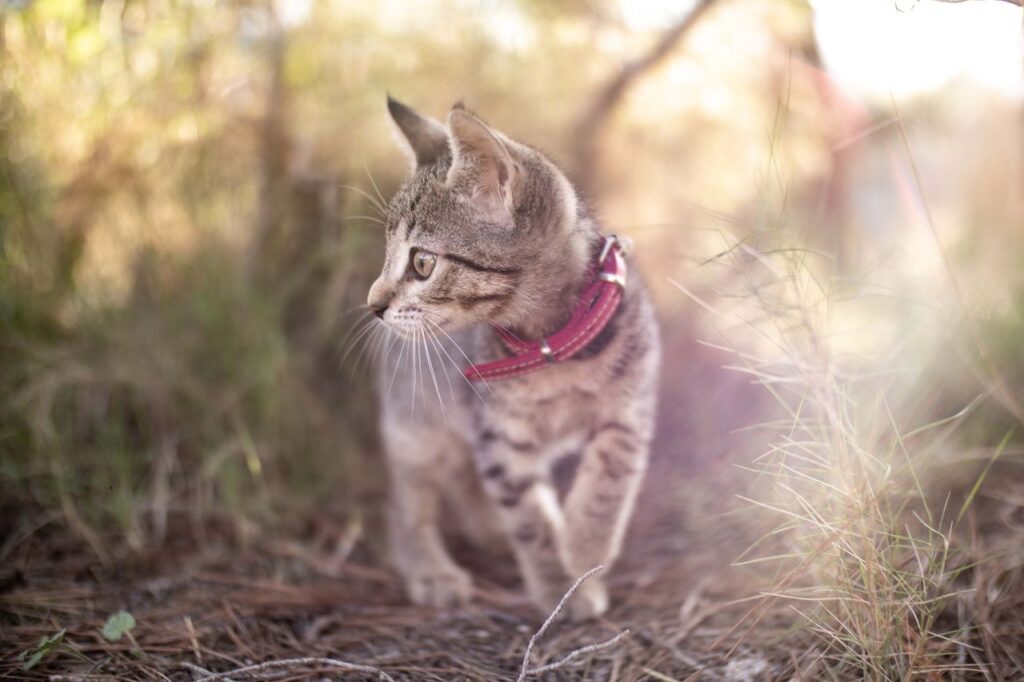
Choosing an adjustable cat collar with buckle involves more than finding an attractive color or a strap that fits around your cat’s neck. The fastening mechanism, available adjustment range, material, weight, and overall construction all affect whether a collar is appropriate for everyday use.
A collar may provide a place for visible identification and help distinguish your cat from other animals. However, not every collar is designed to release when caught on furniture, branches, or other objects. An adjustable strap can improve fit, but adjustability alone does not make a collar safe.
This guide explains how to compare buckle types, measure your cat’s neck, evaluate leather construction, and recognize when another collar design would be a better choice.
Fashion Pulsses offers a cat-collar collection that includes leather options. Before purchasing a particular model, check its current product description and fastening mechanism carefully. A conventional fixed buckle should not be assumed to have the safety characteristics of a purpose-designed breakaway collar.
Table of Contents
- What Is an Adjustable Cat Collar with Buckle?
- Traditional Buckle vs. Breakaway Cat Collar
- Which Cat Collar Style Should You Choose?
- How to Measure Your Cat’s Neck
- Choosing an Adjustable Kitten Collar
- Leather Quality: What Buyers Should Know
- How to Care for a Leather Cat Collar
- Who Should Reconsider a Fixed-Buckle Collar?
- Shopping for Cat Collars at Fashion Pulsses
- Frequently Asked Questions
What Is an Adjustable Cat Collar with Buckle?
An adjustable cat collar has a strap that can be lengthened or shortened to accommodate different neck sizes. Depending on the design, adjustment may be provided by a sliding fitting, a series of holes, or another strap mechanism.
The buckle is the fastening component that holds the collar closed. Its design matters because different buckles behave differently when tension is applied.
A conventional buckle may stay closed under substantial pulling force. A breakaway buckle, by contrast, is specifically designed to open when sufficient pressure is applied. This release feature can reduce the risk of a cat becoming trapped if its collar catches on something.
These terms describe different characteristics:
- Adjustable cat collar: Allows the circumference to be changed.
- Cat collar with buckle: Uses a fastening component to close the strap.
- Breakaway cat collar: Incorporates a release mechanism intended to open under pressure.
- Quick-release cat collar: Commonly refers to a collar with a fast-opening safety mechanism.
A collar can be adjustable without being breakaway. Buyers should check the actual mechanism rather than infer safety from the product title.
For cats, animal-welfare organizations recommend purpose-designed quick-release collars instead of fixed-buckle designs. No collar eliminates every risk, so fit and regular inspection remain essential.
Traditional Buckle vs. Breakaway Cat Collar
The most important distinction when shopping for a cat collar is whether its fastening mechanism can release if the collar becomes caught.
A traditional fixed buckle may resemble the fastening on a belt. It can provide a secure closure, but that is not necessarily the feature a cat needs. Cats climb, squeeze through small openings, groom themselves, and explore places where a collar can snag.
A breakaway mechanism is designed to open when pressure reaches its release threshold. This allows the collar to separate rather than remain attached while the cat struggles.
| Feature | Traditional fixed buckle | Breakaway buckle |
|---|---|---|
| Main function | Holds the collar closed | Holds the collar closed while providing a release mechanism |
| Adjustment | Depends on strap design | Depends on strap design |
| Response when caught | May remain closed | Designed to release under sufficient pressure |
| Main concern | Entrapment risk if the collar snags | Release performance and correct fit must still be checked |
| Appropriate buying consideration | Do not assume it is suitable for unsupervised cat wear | Prefer a cat-specific design with a functioning release mechanism |
Buying advice: For a cat’s everyday collar, prioritize a properly fitted, cat-specific breakaway design. If you are considering a leather collar with a conventional buckle, establish exactly how it fastens and whether it has a genuine breakaway feature before using it on your cat.
A decorative clasp, an adjustable strap, or a buckle that opens by hand does not automatically qualify as a safety-release mechanism.
Never rely on a collar to prevent a cat from escaping, becoming injured, or getting lost.
Which Cat Collar Style Should You Choose?
Different collar designs serve different preferences. The correct choice depends on the cat’s size, activity, tolerance for wearing accessories, and the collar’s intended use.
| Collar style | Potential advantage | What to check before buying |
|---|---|---|
| Adjustable breakaway collar | Allows fit adjustment and has a release mechanism | Size range, release function, strap weight, and hardware |
| Lightweight adjustable collar | May be more comfortable for cats sensitive to heavier accessories | Material, edge finish, and fastening design |
| Cat collar with bell | Makes the cat’s movement easier to hear and may reduce hunting success in some circumstances | Bell attachment, snagging risks, and whether the collar remains breakaway |
| Reflective cat collar | Can improve visibility when light reaches the reflective material | Reflective coverage, fit, and release mechanism |
| Leather cat collar | Offers a distinctive appearance and a material that can develop character with use | Exact leather description, flexibility, weight, stitching, and fastening safety |
A cat collar with bell deserves additional consideration. Bells and other attachments can snag on objects or catch claws. If you choose one, check that the attachment is secure, appropriately lightweight, and does not interfere with the release mechanism.
Appearance should come after fit and safety. Cute cat collars can be colorful, understated, or made from leather, but decorative features do not compensate for an unsuitable fastening system.
How to Measure Your Cat’s Neck
An adjustable cat collar only works when your cat’s neck falls within the manufacturer’s stated size range. Measuring first is more reliable than choosing a collar simply because it is described as suitable for kittens or adult cats.
Step 1: Measure the neck circumference
Use a flexible measuring tape. Wrap it around the area where the collar will normally sit, keeping it flat against the fur without compressing the neck.
Record the measurement in inches.
If you do not have a flexible measuring tape, use a non-stretch piece of string and then measure the string against a ruler.
Step 2: Compare the measurement with the product specifications
Check the product’s minimum and maximum adjustable circumference. Your cat’s measured neck must fit within that range while allowing for a comfortable fit.
Do not assume that all adjustable cat collars share the same dimensions. A product described as one-size-fits-most may still be unsuitable for a particularly small kitten or a large adult cat.
Step 3: Apply the two-finger fit rule
After fitting the collar, you should be able to slide two fingers comfortably between the collar and your cat’s neck.
The collar should not press tightly against the neck. It should also not hang so loosely that your cat can slip a jaw or leg underneath it.
The two-finger check is a practical starting point, not a substitute for the manufacturer’s fitting instructions or observation of your individual cat.
Step 4: Recheck the fit
Check the fit again after your cat has moved around. Look for rubbing, trapped fur, unusual scratching, or signs of discomfort.
Inspect the collar regularly, particularly after changes in weight or coat condition.
For kittens, check the fit at least weekly while they grow, and more frequently if their size is changing quickly. Replace a collar that has become damaged or no longer fits correctly.
Choosing an Adjustable Kitten Collar
A kitten collar requires additional attention because kittens grow rapidly and may be smaller or less tolerant of accessories than adult cats.
A collar that fits today may become too tight as the kitten grows. Conversely, a collar that is adjusted too loosely may catch on the kitten’s jaw or legs.
Before purchasing a kitten collar, check:
- The minimum adjustable neck circumference.
- The strap’s width, thickness, and overall weight.
- Whether the fastening mechanism is designed for cats.
- Whether the breakaway mechanism works appropriately for a cat of that size.
- Whether the collar can be inspected and adjusted easily.
Do not assume a breakaway buckle will function correctly for every kitten. Some mechanisms require a certain amount of force to open, and a small or lightweight kitten may not apply enough force in a particular entanglement.
Introduce a new collar gradually and supervise your kitten while assessing its comfort. Remove it if it causes distress or repeatedly catches on the kitten’s mouth, legs, or surroundings.
If you cannot verify that a collar is suitable for your kitten’s size and safety needs, choose a product with clearer specifications rather than guessing.
Leather Quality: What Buyers Should Know
Leather can be an appealing material for accessories because of its texture, appearance, and ability to develop character over time. However, leather products vary considerably in quality and construction.
Understanding common leather descriptions helps buyers evaluate product claims without assuming that every leather collar uses the same material.
Full-grain leather
Full-grain leather retains the hide’s original grain surface, with limited alteration to that surface. It is often valued for its natural appearance and potential to develop a patina.
Its characteristics still depend on the hide, tanning process, thickness, finishing, and construction. Full-grain leather is not automatically suitable for every pet product.
Top-grain leather
Top-grain leather has had its outer surface altered or refined to some degree. The finish may be more uniform than that of full-grain leather.
Its flexibility, resistance to wear, and surface characteristics vary by manufacturing process and finish.
Genuine leather
Genuine leather is a broad commercial description indicating leather material. It does not, by itself, establish that a product is full-grain, top-grain, or superior to every other leather product.
Buyers should look for more detailed specifications when they matter to the purchasing decision.
Bonded leather
Bonded leather is made using leather fibers or remnants combined with binding materials. Its structure differs from that of a continuous piece of hide.
Its performance depends on the composition, binder, surface coating, and manufacturing process.
What matters for a cat collar?
Regardless of the grade, inspect the entire product rather than judging it by the word leather alone.
Check the strap’s flexibility, the edges, stitching, holes, adjustment fittings, and any areas that could rub against the cat’s skin. Examine the fastening mechanism separately because leather quality does not determine whether a collar is breakaway.
Leather can also be less forgiving of repeated moisture exposure than some synthetic materials. Depending on its finish, it may stiffen, stain, or change shape if handled incorrectly.
A leather collar should therefore be selected on the basis of its actual specifications, construction, fit, and suitability for the cat—not simply its material description.
How to Care for a Leather Cat Collar
Appropriate care can help maintain the appearance of a leather collar, but it cannot make an unsuitable fastening mechanism safe.
Clean gently
Remove the collar before cleaning it. Wipe surface dirt away with a soft, slightly damp cloth, provided the manufacturer’s care instructions permit this.
Avoid soaking the leather, using harsh household cleaners, or scrubbing the surface aggressively.
Condition only when appropriate
Some finished leathers benefit from a compatible leather conditioner. Others may be affected by oils, waxes, or products that alter the finish.
Follow the manufacturer’s instructions and test any approved care product on a small, inconspicuous area first.
Do not apply a conditioner that leaves a greasy or tacky residue where the collar contacts your cat.
Dry naturally
If the collar becomes damp, allow it to dry naturally away from direct heat and strong sunlight. Do not use a heater or hair dryer to accelerate the process.
Excessive heat can affect the leather and may damage adhesives, coatings, or hardware.
Inspect the construction
Check the strap, stitching, holes, adjustment mechanism, and buckle for cracking, stretching, corrosion, loose parts, or other damage.
A collar that looks attractive can still be unsuitable if its hardware is damaged or its release mechanism no longer works correctly.
Store appropriately
When the collar is not in use, store it in a clean, dry place away from excessive humidity and direct sunlight.
Keep leather-care products and small accessories out of your cat’s reach.
Who Should Reconsider a Fixed-Buckle Collar?
A traditional fixed-buckle collar is not the right choice for every cat.
Reconsider it if your cat climbs, explores outdoors, squeezes through narrow spaces, or is regularly left unsupervised. A fixed fastening may remain closed if the collar catches on an object.
A purpose-designed breakaway collar is generally the more appropriate choice for cats because it is intended to release under pressure. Even then, it must fit correctly and have a functioning mechanism.
You should also reconsider a particular collar if:
- The manufacturer does not clearly describe its fastening mechanism.
- The adjustable range does not fit your cat.
- The strap is stiff, heavy, or uncomfortable.
- The hardware has sharp edges or loose components.
- The collar causes rubbing or repeated distress.
- The product’s construction makes it difficult to inspect or clean.
A synthetic collar may be a more practical option for cats that frequently encounter moisture or need a particularly lightweight accessory. Material choice should follow your cat’s needs rather than an assumption that leather is always superior.
If your cat consistently dislikes wearing a collar, do not force the issue without considering other identification options. Microchipping provides an additional identification method and should not be replaced by a collar alone.
Shopping for Cat Collars at Fashion Pulsses
Fashion Pulsses offers a cat-collar category that includes leather options. The collection provides a starting point for shoppers comparing styles and materials.
Before choosing a product, read the current product description and confirm the exact material, size range, fastening mechanism, and care instructions.
If you are looking for an adjustable cat collar with buckle, pay particular attention to whether the buckle is a conventional fixed closure or a genuine breakaway design.
Do not infer that a leather collar has a breakaway mechanism simply because it is adjustable or marketed for cats. If the product page does not provide enough information, seek clarification before using it.
Explore the Fashion Pulsses cat-collar collection to review the available options.
Choose the collar that fits your cat’s measurements and safety requirements rather than selecting solely on appearance.
Frequently Asked Questions
1. What is an adjustable cat collar with buckle?
It is a cat collar with a strap that can be lengthened or shortened and a buckle or fastening mechanism that closes it. Adjustment and breakaway functionality are separate features, so buyers should verify both.
2. Is a traditional buckle safe for a cat?
A conventional fixed buckle may stay closed if a cat’s collar becomes caught. Animal-welfare organizations generally recommend purpose-designed quick-release or breakaway collars for cats because the mechanism is intended to open under pressure.
3. How tight should an adjustable cat collar be?
You should generally be able to fit two fingers comfortably between the collar and your cat’s neck. The collar should not be so tight that it presses into the neck or so loose that a jaw or leg can become trapped underneath it.
4. Can a kitten wear an adjustable cat collar?
A kitten can wear a suitable collar if the product is designed for its size and the fastening mechanism is appropriate. Measure the kitten’s neck, check the minimum adjustable circumference, and inspect the fit frequently as the kitten grows.
5. Should a cat collar have a bell?
A bell can make a cat easier to hear and may help reduce hunting success in some circumstances. However, bells and other attachments can snag or catch claws, so consider their size, attachment, and compatibility with the collar’s release mechanism.
6. Is genuine leather the same as full-grain leather?
No. Genuine leather is a broad commercial description, while full-grain leather refers to leather that retains its original grain surface with limited alteration. A product should not be described as full-grain unless its specifications substantiate that claim.
7. How do I clean a leather cat collar?
Remove the collar before cleaning it. Use a soft cloth and follow the manufacturer’s care instructions. Avoid soaking the leather, harsh cleaners, and excessive heat. Inspect the stitching and hardware before putting the collar back on your cat.
8. Does an adjustable collar prevent a cat from escaping?
No. Adjustability helps establish a suitable fit, but it does not guarantee that a cat cannot escape or become trapped. A properly fitted, cat-specific breakaway design is generally preferred, and a collar should not replace microchipping.
9. How often should I check my cat’s collar?
Inspect the fit and condition regularly. Check kittens at least weekly while they grow, and recheck adult cats frequently, especially after changes in weight, coat, or activity. Replace damaged collars and verify that the release mechanism continues to work as intended.
10. Where can I shop for leather cat collars?
You can explore the Fashion Pulsses cat-collar collection. Check each product’s current specifications and confirm that its fastening mechanism meets your cat’s needs before purchasing.
Conclusion
Choosing an adjustable cat collar with buckle means balancing fit, material, construction, and safety. Measure your cat’s neck carefully, apply the two-finger fit rule, and inspect the strap and hardware regularly.
Most importantly, do not confuse an adjustable conventional buckle with a breakaway mechanism. For cats, a properly fitted collar designed to release under pressure is generally the safer choice.
Explore the cat-collar collection at Fashion Pulsses, compare the available product details, and select an option that meets your cat’s actual size and safety requirements.
