The right men’s accessories do more than complete an outfit. They help organize everyday essentials, add character to familiar clothing, and make getting dressed feel more intentional. A well-chosen wallet, a properly fitted leather belt, or a practical keyring can become part of a daily routine without demanding much attention.
For men building a versatile accessory collection, the best starting point is usually function. Consider what you carry, how you dress, and which items you use most often. Then evaluate materials, construction, fit, and price before buying.
This guide to men’s accessories focuses on genuine leather goods available from Fashion Pulsses, including men’s wallets and leather belts. You’ll learn how to compare styles, understand leather terminology, select the right fit, care for your purchases, and decide when leather may not be the most practical choice.
The aim isn’t to buy more accessories. It’s to choose the right ones for your routine.
Table of Contents
- What Makes Men’s Accessories Worth Buying?
- Essential Leather Accessories for Men
- Compare Wallets, Belts, and Keyrings
- How to Choose the Right Size and Fit
- Understanding Leather Grades
- Construction, Price, and Long-Term Value
- How to Style Men’s Leather Accessories
- Who Should Reconsider Leather?
- Leather Accessories as Gifts
- How to Care for Leather Accessories
- Shopping for Men’s Accessories at Fashion Pulsses
- Frequently Asked Questions
What Makes Men’s Accessories Worth Buying?
Useful accessories solve everyday problems while complementing the clothes you already own. Before purchasing anything, consider three questions: Will you use it regularly? Does it suit your existing wardrobe? Can you maintain it without unnecessary effort?
These questions help separate practical purchases from items that look appealing online but rarely leave a drawer.
Prioritize everyday function
A wallet keeps cards and cash together. A belt helps secure trousers and can create a visual connection between shoes and other leather goods. A keyring keeps keys organized and makes them easier to find.
These items earn their place through regular use rather than novelty.
Choose versatility over quantity
A black or brown wallet can work with many outfits. A neutral leather belt can complement jeans, chinos, and selected business-casual combinations. If your wardrobe already includes several neutral colors, an accessory with a distinctive finish can add personality without requiring an entirely new outfit.
Evaluate the complete purchase
Affordable luxury men’s accessories aren’t necessarily those with the most expensive labels. A more useful evaluation considers material disclosure, dimensions, construction details, expected maintenance, and the item’s role in your routine.
A higher price does not automatically establish superior leather or craftsmanship. Likewise, a lower price does not tell you everything about a product’s usefulness.
Start with your needs, then compare the available options.
Essential Men’s Accessories: Wallets, Belts, and Keyrings
Fashion Pulsses concentrates on leather goods, making its wallets and belts natural starting points for men building a practical accessory collection.
1. Men’s leather wallets
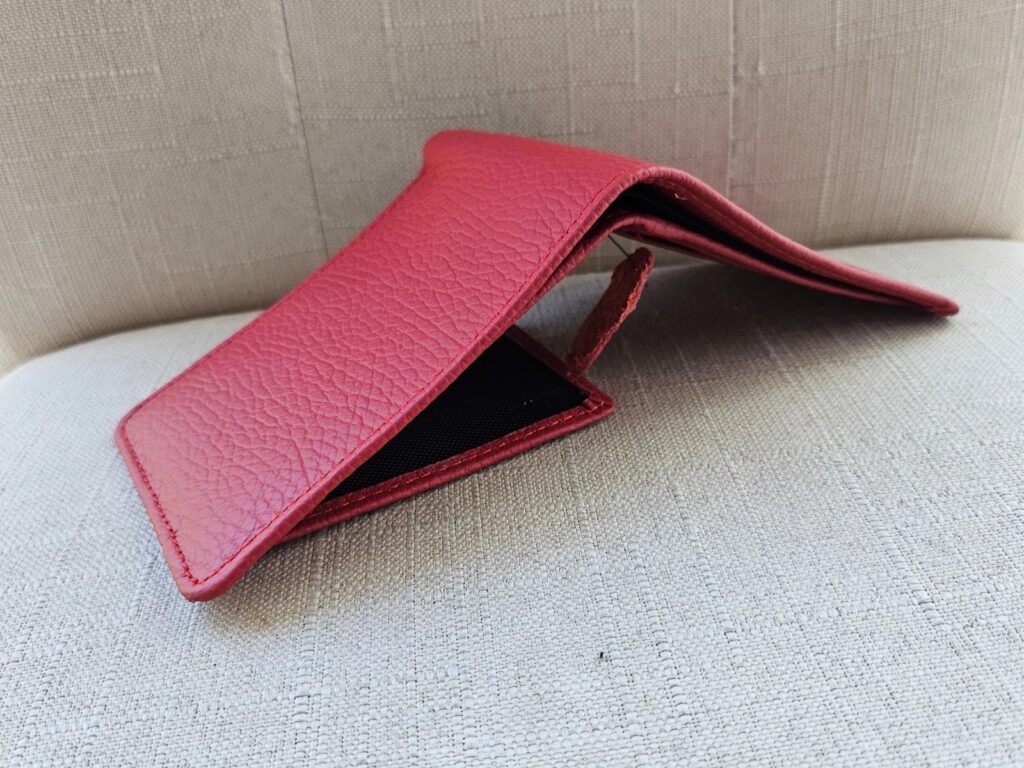
A wallet is one of the most frequently handled men’s accessories. Its dimensions, storage layout, and folding style affect comfort every time you sit down, reach for a card, or put it in a pocket.
A bifold wallet folds in half and is a familiar option for carrying cards and folded cash. A slim cardholder is more suitable for someone who carries only a few cards and wants to minimize pocket bulk. A longer wallet can suit someone who prefers a larger format, although it may be less convenient for a front or back trouser pocket.
Fashion Pulsses lists several wallet styles, including the Dark Silver Leather Wallet Billfold Multiple Compartments Cardholder Handmade. Its product page describes the material as genuine leather, identifies the color as dark silver, and lists dimensions of 4.5 × 3.5 inches. The displayed price during this research was $39.00.
That gives shoppers specific details to evaluate. However, the listing does not establish a full-grain classification, RFID protection, or a guaranteed lifespan.
For more options, browse the men’s wallet collection and compare the current product descriptions before deciding.
2. Leather belts
A belt should fit comfortably, work with the trousers you wear, and complement the formality of your outfit.
For business-casual or dressier clothing, a relatively understated belt with a restrained buckle can be versatile. Casual outfits provide more room for textured leather, distinctive colors, and decorative finishes.
Fashion Pulsses lists the Handcrafted Belt Burgundy Genuine Leather Black Tone Buckle Waistband Size 38. The live listing specifies a 38–39-inch size and a 1.5-inch width, with a displayed price of $39.00 during research.
These specifications are useful when comparing products, but don’t assume that every belt marked size 38 will fit identically. Check the actual listing and measurement method.
Browse the leather belt collection to compare the available sizes, colors, and styles.
3. Leather keyrings
A leather keyring is a small addition to an everyday-carry setup. It can help keep keys together and coordinate with a wallet or belt without creating a matching set that looks overly deliberate.
Before buying, check the attachment mechanism, overall dimensions, and whether the design accommodates the number of keys you carry.
For a minimalist approach, keep your keyring compact. A bulky collection of keys can create more pocket discomfort than the wallet itself.
4. Bags and other accessories
A crossbody bag can be useful when pockets aren’t sufficient, while a suitable laptop bag can help organize work essentials. However, capacity, strap comfort, and dimensions matter more than appearance alone.
Confirm that the specific item you want is currently available and that its product description supports your intended use. Do not assume a bag is compatible with a particular laptop size unless the listing provides enough information.
The same principle applies across stylish accessories for men: choose an item because it serves a purpose, then decide whether its design suits your wardrobe.
Compare Men’s Accessories Before You Buy
Different accessory styles solve different problems. Use this table to narrow your choices before comparing individual products.
| Accessory or style | Best for | Capacity or fit | What to check before buying |
|---|---|---|---|
| Bifold wallet | Everyday cards and folded cash | Moderate carrying capacity; folds in half | Dimensions, card-slot layout, closure, and pocket comfort |
| Slim cardholder | Minimalist carry | A smaller card collection | Number of slots and whether cash storage is necessary |
| Long wallet | People who prefer a larger format | More space depending on design | Overall length, compartment layout, and portability |
| Classic leather belt | Everyday and business-casual outfits | Must fit the wearer’s waist and belt loops | Actual length, width, buckle, and material description |
| Statement belt | Casual or distinctive outfits | Fit depends on the individual listing | Pattern, buckle style, width, and wardrobe compatibility |
| Leather keyring | Organizing keys | Depends on the attachment and design | Hardware, dimensions, and key capacity |
| Crossbody bag | Carrying essentials hands-free | Depends on the bag’s dimensions | Strap adjustment, loaded comfort, closures, and capacity |
The most useful starting point for many buyers is a wallet and belt that work with several existing outfits. Add a keyring or bag only when it solves a real need.
Shop the available men’s wallet styles after deciding how much you carry and how you prefer to store it.
How to Choose the Right Size and Fit
Good-looking accessories become frustrating when they are uncomfortable or impractical. Measurements can help reduce that risk, particularly when buying online.
Wallet dimensions
Fashion Pulsses lists the Dark Silver Leather Wallet at 4.5 × 3.5 inches. This is the product’s stated size, not a universal measurement for every wallet in the store.
Before buying, measure a wallet you already use and like. Compare its dimensions with the new listing. If possible, also compare its thickness when loaded with your usual cards and cash.
Consider these points:
- Pocket placement: Will the wallet sit comfortably in your preferred pocket?
- Card capacity: Does the layout match the cards you actually carry?
- Cash storage: Do you need a full bill compartment or only occasional cash storage?
- Loaded thickness: A wallet that looks slim when empty may become bulky when filled.
Remove expired cards and old receipts before deciding you need a larger wallet. Reducing unnecessary contents can improve comfort without replacing the accessory.
Belt sizing
A common starting point when selecting a belt is to choose a size approximately 2 inches larger than your trouser waist measurement. However, sizing conventions vary by manufacturer and product, so treat this as a guideline rather than a guarantee.
For a more reliable selection:
- Measure your waist where you normally wear the belt, or measure a belt that currently fits.
- Check the product’s stated length and sizing method.
- Confirm the belt width is compatible with your trouser loops.
- Consider whether you will wear it over lightweight trousers or thicker denim.
- Read the individual listing before ordering.
For example, Fashion Pulsses lists a burgundy belt in a 38–39-inch size with a width of 1.5 inches. Use those published specifications to compare the product against your own measurements.
If your waist measurement falls between available sizes, don’t assume the next size up or down will work without checking the seller’s sizing convention.
Understanding Leather Grades Before Buying
Leather terminology can make shopping confusing because product descriptions sometimes use material words as if they were interchangeable. They aren’t.
Understanding the main distinctions helps you assess men’s leather accessories without relying on marketing language alone.
Full-grain leather
Full-grain leather retains the outer grain surface of the hide without removing that surface through corrective sanding. Natural markings may remain visible.
Its performance still depends on the hide, tanning, thickness, finishing, and construction. The term alone does not guarantee that every product will be exceptionally durable or appropriate for every use.
Top-grain leather
Top-grain leather comes from the upper portion of the hide but may have its surface corrected or sanded. Finishes can create a more uniform appearance.
It can be suitable for many accessories, but quality varies with the underlying material and manufacturing process.
Genuine leather
Genuine leather is a broad material description, not a synonym for full-grain leather.
When a product listing says genuine leather, you can report that stated material description. You should not infer the exact layer of hide, tanning method, or expected lifespan unless the seller supplies that information.
This distinction matters when evaluating Fashion Pulsses products. For example, the Dark Silver Leather Wallet is listed as genuine leather. The product page does not establish that it is full-grain or top-grain.
That is why the specific product description should guide your decision.
Bonded leather
Bonded leather is made using leather fibers or remnants combined with binding materials to form a composite material. Its construction differs from that of a continuous piece of hide.
Don’t treat bonded leather as equivalent to full-grain, top-grain, or a product simply described as genuine leather.
Leather-grade comparison
| Material description | What it tells you | What you still need to check |
|---|---|---|
| Full-grain | The grain surface has not been removed through corrective sanding | Hide quality, finish, construction, and intended use |
| Top-grain | The material comes from the upper hide and may have a corrected surface | Coating, flexibility, construction, and specifications |
| Genuine leather | The seller identifies the material as genuine leather | Exact grade, construction, finish, and other material details |
| Bonded leather | The material incorporates bonded leather fibers or remnants | Composition, coating, expected use, and care requirements |
Buying principle: A clearly described product is easier to evaluate than one relying on broad claims about luxury or quality.
Construction, Price, and Long-Term Value
When comparing affordable luxury men’s accessories, evaluate what the listing actually tells you rather than assuming a higher price means better construction.
Look at the stitching, edges, hardware, closures, material description, and available dimensions. Product photographs can help you inspect visible details, although they cannot establish every aspect of manufacturing quality.
Calculate cost per year realistically
Cost per year is a useful comparison method, provided you use reasonable estimates rather than promised lifespans.
For example, imagine a wallet costs $40 and you estimate that you will use it for four years.
$40 ÷ 4 years = $10 per year.
Now imagine another wallet costs $60 and you estimate that you will use it for six years.
$60 ÷ 6 years = $10 per year.
These are hypothetical calculations, not product-life predictions or verified lifespans for Fashion Pulsses products.
The exercise helps you compare purchase price with your own expected use. It also encourages you to consider whether an accessory is comfortable and useful enough to carry regularly.
What construction details matter?
For a wallet, inspect the fold, stitching, edge finish, card-slot arrangement, and closure. For a belt, check the buckle attachment, holes, edges, and width.
Ask yourself whether the product’s visible construction suits the way you intend to use it. Avoid assuming that handmade or handcrafted wording establishes every aspect of quality.
Fashion Pulsses describes selected products as handmade or handcrafted. Those descriptions can inform your comparison, but they should not be treated as proof of a particular leather grade or guaranteed lifespan.
How to Style Men’s Leather Accessories
The simplest way to coordinate men’s fashion accessories is to begin with the clothes you already wear.
Casual outfits
A leather wallet, everyday belt, and compact keyring can form a practical foundation for jeans, casual trousers, and simple shirts.
If your clothes feature neutral colors, a burgundy or textured belt can introduce contrast. Keep the remaining accessories relatively understated if the belt is intended to stand out.
Business-casual outfits
For chinos, button-down shirts, and smart-casual shoes, consider a restrained belt design and a wallet that fits comfortably in your pocket.
Black and brown leather are versatile starting points, but exact matching isn’t necessary. Aim for a coordinated overall appearance rather than identical colors and finishes.
Minimalist styling
Minimalist accessories for men are about deliberate choices, not simply buying the smallest product available.
Carry the cards you need. Select a wallet that fits comfortably. Choose a belt that suits your trousers. Add other items only if they contribute something useful or meaningful.
You can also introduce one distinctive accessory without making the rest of your outfit complicated.
Evaluating men’s accessories brands
When comparing brands, prioritize clear product descriptions, transparent sizing, accessible policies, and consistent information between category pages and individual listings.
Don’t judge a retailer solely by promotional language. Check the actual specifications and make sure you understand the terms that apply to your order.
Who Should Reconsider Leather Accessories?
Leather is not the right choice for every shopper or every situation.
Consider an alternative if:
- You prefer animal-free materials. A verified vegan or synthetic alternative may align better with your preferences.
- You need frequent water exposure. Leather can be damaged by soaking, and some finishes are more moisture-sensitive than others. A material specifically designed for wet conditions may be more practical.
- You want the lightest possible carry. A compact synthetic or metal cardholder may be preferable to a larger leather wallet.
- Your main priority is the lowest possible purchase price. Compare suitable materials and construction rather than paying for a feature you don’t need.
- You don’t want maintenance. Leather benefits from appropriate cleaning, careful drying, and storage.
Choosing another material is not a failure to appreciate quality. It simply means matching the product to your circumstances.
The most suitable accessory is one you can use comfortably and maintain appropriately.
Leather Accessories as Gifts for Men
Wallets and belts are practical gift options because they can fit into an existing routine. They can work for birthdays, Father’s Day, Christmas, graduations, and other milestones.
Leather is also traditionally associated with the third wedding anniversary, making a leather accessory a potential gift for that occasion.
Choosing the right gift
Consider the recipient’s habits before choosing a style.
- A slim cardholder may suit someone who carries only a few cards.
- A bifold may be more appropriate for someone who uses cash regularly.
- A classic belt can be practical if you know the recipient’s size.
- A distinctive wallet may appeal to someone who prefers unusual colors or textures.
When buying a belt as a gift, verify the actual sizing convention. If you don’t know the recipient’s measurements, a wallet may be a simpler choice.
Plan around delivery times
Fashion Pulsses’ published shipping policy states that order processing takes 5–10 business days, followed by standard shipping of 5–7 business days or express shipping of 2–3 business days.
These stages should be considered together when planning a gift. They indicate an approximate planning window of 10–17 business days for processing plus standard shipping, or 7–13 business days for processing plus express shipping, before accounting for unexpected delays.
These are planning estimates, not delivery guarantees. Allow additional time before birthdays, holidays, and other fixed dates, and check the live policy when placing an order.
Shipping charges are calculated at checkout. No free-shipping offer is assumed in this guide.
How to Care for Leather Wallets and Belts
Proper care helps keep leather accessories presentable, but different finishes may require different products and methods.
Cleaning
Remove loose dust with a soft, dry cloth. For surface dirt, follow the product’s care instructions and test any appropriate cleaner on an inconspicuous area first.
Avoid soaking leather or applying harsh household cleaners without checking compatibility.
For hair-on leather, use particular care with the textured surface. Brush gently in the direction of the hair where appropriate, and avoid treating the hair-covered area as though it were smooth finished leather.
Conditioning
Conditioning may help some leather finishes remain supple, but not every product requires the same treatment.
Use a conditioner suitable for the specific leather and finish. Test it in an inconspicuous area first, since some products may darken leather or change its appearance.
Do not assume that a conditioner intended for smooth leather is suitable for a hair-on surface.
Drying and storage
If a wallet or belt becomes wet, blot away excess moisture and let it dry naturally at room temperature. Avoid radiators, hair dryers, and other direct heat sources.
Store leather goods in a cool, dry location away from prolonged direct sunlight. Avoid leaving a wallet tightly overstuffed, since excessive contents can strain its seams and alter its shape.
Regular, gentle care is preferable to aggressive treatment after visible damage appears.
Shopping for Men’s Accessories at Fashion Pulsses
Fashion Pulsses offers a practical starting point for shoppers interested in men’s leather wallets and belts.
The men’s wallet collection includes products with different colors, designs, and stated material descriptions. The leather belt category includes conventional styles and more distinctive options, including hair-on designs.
Two live examples illustrate the range:
- Dark Silver Leather Wallet Billfold Multiple Compartments Cardholder Handmade: listed at $39.00 during research, with stated dimensions of 4.5 × 3.5 inches and a genuine-leather description.
- Handcrafted Belt Burgundy Genuine Leather Black Tone Buckle Waistband Size 38: listed at $39.00 during research, with a stated size of 38–39 inches and a width of 1.5 inches.
These prices were observed on November 3, 2026, and may change. Check the individual product pages for current prices, availability, and specifications.
Before purchasing, review the shipping and returns policies as well. The published returns policy allows eligible return requests within 15 days of receipt, subject to the stated condition and other requirements.
A considered purchase starts with an accurate description, a suitable fit, and realistic expectations.
Explore men’s leather accessories at Fashion Pulsses and choose the wallet or belt that best suits your everyday routine.
Frequently Asked Questions About Men’s Accessories
1. Which men’s accessories are most useful for everyday wear?
A wallet and a properly fitted belt are useful starting points for many men. A keyring can help organize keys, while a bag may be useful if you regularly carry a laptop or other essentials. Choose accessories according to your routine rather than buying every available style.
2. Which wallet style is best for a minimalist?
A slim cardholder is a good option if you carry only a few cards and rarely need cash. A bifold is more suitable if you need a traditional bill compartment or additional storage. Compare the dimensions and layout before choosing.
3. What is the difference between full-grain and genuine leather?
Full-grain leather retains the grain surface of the hide without corrective sanding that removes that surface. Genuine leather is a broader material description and does not establish that a product is full-grain. Check the exact material wording on the individual product page.
4. How should a man choose the correct belt size?
Measure your waist where you normally wear the belt, or measure a belt that already fits. Waist size plus approximately 2 inches is a common starting point, but manufacturers use different sizing conventions. Always check the product’s stated length, size, and width before ordering.
5. How can shoppers evaluate affordable leather accessories?
Compare the actual price, material description, dimensions, stitching, edge finishing, hardware, and return conditions. A higher price does not automatically prove better quality. Choose the product that meets your needs and provides enough information for an informed decision.
6. How should leather wallets and belts be cared for?
Clean them gently, avoid soaking, dry them away from direct heat, and store them in a cool, dry place. Use a suitable conditioner only when appropriate for the particular leather and finish. Follow any product-specific care instructions.
7. Are leather accessories good gifts for men?
They can be practical gifts for birthdays, Father’s Day, Christmas, graduations, and third wedding anniversaries. A wallet is often easier to choose when you don’t know the recipient’s belt size. Select a style that matches the recipient’s everyday habits.
8. How long should shoppers allow for shipping?
The published Fashion Pulsses policy lists 5–10 business days for processing, followed by 5–7 business days for standard shipping or 2–3 business days for express shipping. These are estimates rather than guaranteed delivery dates. Allow extra time for important occasions.
9. What is the return window at Fashion Pulsses?
The published returns policy allows eligible return or exchange requests within 15 days of receiving an order. Items must meet the stated condition and other eligibility requirements. Approved refunds are typically processed within 5–10 business days after the returned item is received and inspected.
