
Choosing an adjustable leather dog collar involves more than picking an attractive color or finding a buckle that matches your dog’s accessories. The right collar should fit comfortably, use clearly identified materials, provide dependable hardware, and suit your dog’s size and everyday activities.
Leather remains a popular option among dog owners who appreciate its traditional appearance, natural texture, and potential for long-term use. However, not every leather collar offers the same quality. Differences in leather construction, strap width, stitching, adjustment holes, and buckle materials can affect how a collar performs over time.
Whether you’re shopping for a small companion dog, a large breed, or a personalized accessory, understanding these details can help you make a better purchase. This guide explains what to look for in an adjustable leather dog collar, how to measure your dog’s neck, how different leather types compare, and which features matter most before buying.
What Is an Adjustable Leather Dog Collar?
An adjustable leather dog collar is a neck strap made from leather that uses a buckle and multiple adjustment holes to accommodate different neck measurements. Unlike fixed-size accessories, an adjustable collar allows owners to change the fit within the manufacturer’s specified size range.
Most traditional designs include:
- A leather strap.
- A metal buckle.
- Multiple adjustment holes.
- A D-ring for attaching a leash or identification tag.
- A buckle loop or leather keeper to secure excess strap length.
Some designs also feature decorative stitching, metal studs, engraved nameplates, or additional padding. The main advantage is flexibility. A properly sized adjustable collar can accommodate small changes in fit without requiring an entirely new accessory. However, adjustability does not mean one collar fits every dog. The actual neck-size range, strap width, and hardware strength must match the individual animal.
How to Choose the Right Leather for a Dog Collar
Leather quality is one of the most important considerations when buying a leather dog collar.
Product descriptions sometimes use terms such as genuine leather, premium leather, handmade leather, and full-grain leather interchangeably. These expressions do not necessarily describe the same material or construction quality.
1. Full-Grain Leather
Full-grain leather retains the natural grain surface of the hide. It is often selected for premium leather accessories because its natural surface remains visible rather than being sanded away to create a more uniform appearance. When properly constructed and maintained, a full-grain leather collar can develop an attractive patina through regular use.
Look for clear material descriptions rather than relying on product photographs alone.
2. Top-Grain Leather
Top-grain leather has been processed to create a more consistent surface. It can offer a smooth appearance and practical durability, making it another option for everyday leather accessories. The finish and thickness still matter, so a top-grain label alone does not establish whether a particular collar is suitable for your dog.
3. Genuine Leather
Genuine leather is a broad commercial description that does not, by itself, establish that a product is full-grain or top-grain. Buyers should check the manufacturer’s material information and construction details. The Federal Trade Commission’s leather guides address misleading representations concerning leather and imitation-leather composition.
Federal Trade Commission+1
4. Vegetable-Tanned Leather
Vegetable tanning uses plant-derived tannins during the leather-processing process. This leather can develop a distinctive appearance as it ages. Its firmness, finish, and flexibility depend on the specific leather and manufacturing process.
For dog collars, consider whether the finished material has comfortable edges and sufficient flexibility for everyday wear. Buying tip: Prioritize clearly disclosed leather type, thickness, construction, and finish. A product advertised as premium is not automatically better than another collar with more detailed specifications.
How to Measure Your Dog for an Adjustable Leather Collar
Correct sizing is essential. A collar that is too tight can cause discomfort, while an excessively loose collar may slip over the dog’s head. The American Kennel Club recommends measuring the dog’s neck and checking the fit rather than relying exclusively on generic size labels.
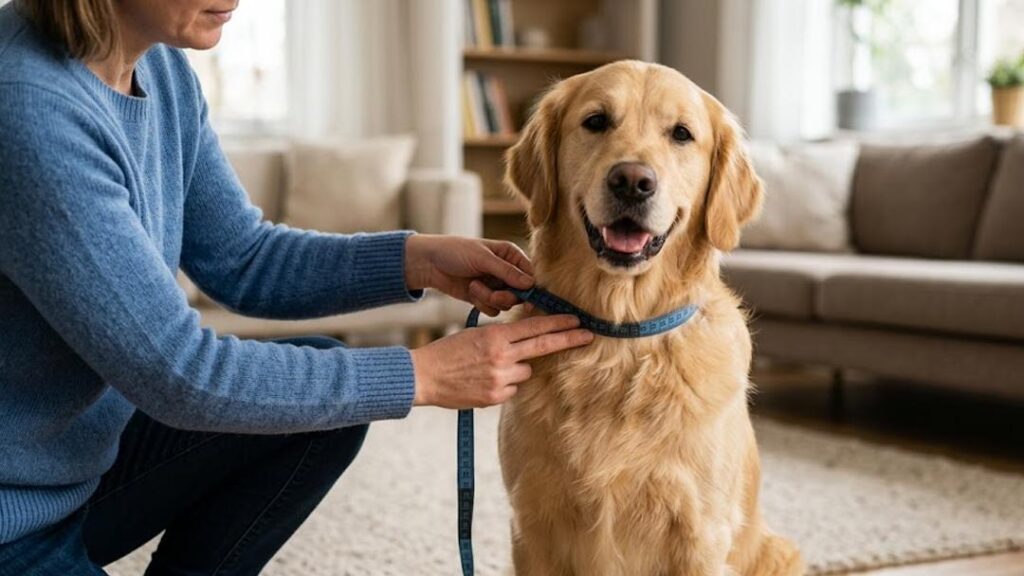
Step 1: Measure the Neck Circumference
Use a flexible measuring tape. Position it around the part of the neck where the collar will naturally sit. Keep the tape comfortably snug without pulling it tightly against the dog’s skin.
Record the measurement in inches.
Step 2: Check the Manufacturer’s Size Range
Compare the measurement with the manufacturer’s actual neck-size chart. For example, if your dog’s neck measures 16 inches, a collar with an adjustable neck range of 15–19 inches may be appropriate, provided its width and design also suit your dog. Do not assume that a collar labeled medium has the same measurements across different brands.
Step 3: Check the Final Fit
Once the collar is fastened, check that it is secure without restricting normal movement or breathing. The American Kennel Club describes the two-finger fit check as a useful general guideline, although appropriate clearance depends on the dog’s size and collar design.
American Kennel Club+1
Step 4: Recheck the Collar Regularly
Check the fit periodically, particularly if:
- Your dog is still growing.
- Your dog’s weight changes.
- The collar stretches or becomes damaged.
- Your dog develops a thicker coat.
- The adjustment buckle or holes begin showing wear.
A collar that fitted correctly several months ago may no longer provide a suitable fit.
Choosing Leather Dog Collars for Large Dogs
Large dogs generally need careful consideration of collar width, hardware, and construction. A wide collar may distribute contact across a larger area of the neck, but width alone does not establish strength or safety. For a larger dog, consider the following features.
Wider Strap Construction
Compare the collar’s width with your dog’s neck size and body proportions. A strap that is too narrow may be uncomfortable or unsuitable for the intended use, while an excessively wide strap may restrict movement.
Strong Buckle and D-Ring
Inspect the buckle, D-ring, rivets, and stitching. The D-ring should be securely attached, and the buckle should close reliably without bending or showing obvious defects. Metal appearance alone does not establish the strength or corrosion resistance of hardware.
Appropriate Leather Construction
Look for clearly disclosed leather thickness, stitching, and edge finishing. A well-finished collar should not have sharp edges, exposed rough layers, or loose stitching.
Consider Your Dog’s Walking Behavior
A leather collar should not automatically be treated as heavy-duty training equipment. If your dog pulls strongly, a properly fitted walking harness may be more appropriate for managing leash pressure. The American Kennel Club discusses situations where harnesses can be preferable to traditional collars.
Choosing a Leather Dog Collar for Small Dogs
Small dogs require a different approach.
A collar designed for a large breed may be unnecessarily heavy or wide for a toy breed or small companion dog.
Consider these features:
- Lightweight leather construction.
- A narrow strap that suits the dog’s neck.
- A small, appropriately sized buckle.
- Smooth inner and outer edges.
- Adjustment holes that provide a suitable fit.
- A secure D-ring that does not add unnecessary weight.
Pay particular attention to buckle size. A large metal buckle may make a small collar uncomfortable, even when the strap itself is appropriately sized.
For puppies, allow for growth but do not purchase a collar that is so large that it can slip off.
Leather Dog Collar With Metal Buckle: What Should You Check?
A metal buckle is an important component of a traditional adjustable leather collar. However, the quality of the metal and how it is attached matter more than appearance.
Buckle Material
Common hardware descriptions include:
- Brass.
- Stainless steel.
- Zinc alloy.
- Nickel-plated metal.
- Other metal alloys.
These materials can differ in weight, corrosion resistance, finish, and durability.
If a manufacturer does not identify the metal, avoid assuming that a gold-colored buckle is solid brass or that a silver-colored buckle is stainless steel.
Adjustment Holes
Check that the holes are evenly spaced and cleanly finished. Poorly finished holes may stretch or tear under repeated use.
The buckle should fit comfortably into the selected adjustment hole without requiring excessive force.
D-Ring Attachment
The D-ring is commonly used for identification tags and leash attachment. Inspect how it connects to the collar. Reinforced stitching, properly secured rivets, and sound construction are important details.
For dogs that pull heavily, do not rely on appearance alone when evaluating the hardware’s suitability.
Flat vs. Rolled Leather Dog Collars
The collar’s shape can influence comfort, appearance, and how it interacts with your dog’s coat.
| Feature | Flat leather collar | Rolled leather collar |
|---|---|---|
| Shape | Flat strap | Rounded strap |
| Appearance | Traditional | Rounded, streamlined |
| Tag attachment | Usually straightforward | Depends on design |
| Coat suitability | General everyday use | Often useful for longer coats |
| Width | Available in various widths | Varies by design |
Flat Leather Collars
Flat collars are common and practical for everyday wear. Their broad surface provides room for a buckle, adjustment holes, and identification-tag attachment.
They are suitable for many dogs when correctly sized.
Rolled Leather Collars
Rolled collars have a rounded construction. They may be worth considering for dogs with longer or feathered coats because the rounded design can reduce some of the friction associated with flat collar edges. However, the individual dog’s coat, collar fit, and construction still matter.
Neither design is automatically superior for every breed.
Personalized and Custom Leather Dog Collars
Personalization can make a leather dog collar more distinctive and useful.
Common options include:
- Engraved metal nameplates.
- Embossed dog names.
- Personalized identification details.
- Custom colors.
- Decorative stitching.
- Custom strap lengths.
A personalized leather dog collar can also reduce dependence on a separate hanging identification tag if the contact information is permanently attached to the collar.
Before ordering, check:
- Whether the nameplate is securely attached.
- How many characters are permitted.
- Whether a telephone number can be included.
- Whether the personalization is engraved or printed.
- Whether the selected collar size supports the nameplate.
- Whether personalized orders can be returned.
For example, Fashion Pulsses’ published returns policy lists customized and personalized products among non-returnable items. Buyers should review the applicable conditions before ordering.
Handmade Leather Dog Collar: Is It Worth Considering?
Handmade leather dog collars can appeal to owners who appreciate traditional construction and individual finishing.
However, handmade does not automatically mean stronger or more durable.
When evaluating a handmade leather dog collar, inspect:
Stitching: Look for consistent stitching without loose threads or uneven gaps.
Edges: Finished edges should feel smooth rather than sharp or rough.
Rivets: Metal fasteners should be securely installed.
Leather quality: The seller should identify the actual leather material.
Hardware: The buckle and D-ring should be appropriately sized and securely attached.
Adjustability: The adjustment range should suit your dog’s neck measurement.
A transparent manufacturer description is more valuable than an unsupported handmade or premium label.
How to Maintain a Leather Dog Collar
Leather requires different care from nylon or canvas. Regular maintenance helps preserve its appearance and condition.
Clean Surface Dirt
Use a soft, slightly damp cloth to remove ordinary surface dirt. Avoid soaking the collar or using aggressive cleaning chemicals unless the manufacturer specifically recommends them.
Allow Natural Drying
If the collar becomes wet, remove excess moisture with a cloth and allow it to air-dry naturally. Avoid placing it near radiators, heaters, or other direct heat sources.
Use Suitable Leather Conditioner
Apply a leather conditioner only when appropriate for the particular leather finish. Follow the manufacturer’s care instructions to avoid discoloration or unwanted changes in texture.
Inspect Hardware and Stitching
Periodically examine the buckle, adjustment holes, D-ring, and stitching. Replace a collar if the leather develops deep cracks, the buckle becomes unreliable, or attachment points show significant damage.
Avoid Prolonged Water Exposure
Ordinary leather collars are not necessarily waterproof. Repeated exposure to water, mud, and moisture can affect leather condition and hardware. For dogs that swim frequently, consider a material specifically designed for wet conditions instead.
Leather vs. Nylon Dog Collars: Which Is Better?
Both materials have practical advantages.
| Consideration | Leather | Nylon |
|---|---|---|
| Appearance | Traditional, natural texture | Wide range of colors and designs |
| Maintenance | Requires leather-specific care | Generally easier to wash |
| Water exposure | Needs more protection | Often more practical |
| Adjustability | Usually buckle and holes | Buckle or adjustment hardware |
| Personalization | Engraving and embossing options | Printed or attached identification |
| Long-term condition | Depends on leather and care | Depends on fabric and hardware |
Leather may suit owners who prioritize natural material and traditional styling. Nylon may be more convenient for dogs that regularly encounter water, mud, or messy outdoor conditions.
Neither material is universally best. Choose according to your dog’s activities, comfort, and the actual product specifications.
For readers considering a non-leather alternative, Fashion Pulsses lists a Premium Adjustable Dog Collar for Small and Large Dogs. This particular product is explicitly described as nylon, with metal hardware and reflective stitching. It is an alternative, not a leather collar.
You can also browse the Fashion Pulsses Dog Collars collection to review its current listings and material descriptions.
Adjustable Leather Dog Collar Buying Checklist
Before purchasing, use this checklist to compare products.
- The manufacturer identifies the leather material.
- The adjustable neck range includes your dog’s measurement.
- The collar width is appropriate for your dog’s size.
- The buckle closes securely.
- The D-ring is securely attached.
- The stitching and rivets are properly finished.
- The edges are smooth and comfortable.
- The collar does not restrict normal movement.
- The cleaning instructions are clear.
- Personalization and return conditions are understood.
- The product description accurately identifies all materials.
A collar that meets these practical requirements is a more informed purchase than one selected solely because it looks attractive.
Frequently Asked Questions
1. How tight should an adjustable leather dog collar be?
An adjustable leather dog collar should fit securely without restricting breathing, movement, or normal neck activity. Use the two-finger fit check as a general guideline, adjusting for your dog’s size and the manufacturer’s fitting instructions.
2. Are genuine leather dog collars better than nylon collars?
Not necessarily. Leather offers a traditional appearance and can provide long-term use with appropriate care. Nylon is often easier to clean and more convenient for wet or muddy activities. The better option depends on your dog’s lifestyle and the quality of the individual product.
3. What width leather dog collar is best for large dogs?
There is no single ideal width for every large dog. Consider the dog’s neck circumference, body proportions, collar weight, and intended use. Check the manufacturer’s size and width specifications before purchasing.
4. Can I get a personalized leather dog collar?
Yes. Some manufacturers offer engraved nameplates, embossed names, and customized strap designs. Check personalization options, character limits, attachment quality, and return conditions before placing an order.
5. How do I clean and maintain a leather dog collar?
Remove dirt with a soft, slightly damp cloth, allow the collar to air-dry naturally, and use an appropriate leather conditioner when recommended by the manufacturer. Avoid prolonged soaking and direct heat.
6. Is an adjustable leather collar suitable for puppies?
It can be suitable if the collar is lightweight, correctly sized, and has sufficient adjustment range. Puppies grow quickly, so check the fit frequently. Do not use an oversized collar simply to accommodate future growth.
Final Thoughts
An adjustable leather dog collar can be a practical accessory for owners who value traditional styling, suitable construction, and a comfortable fit. The most important considerations are leather quality, correct neck measurement, strap width, secure hardware, and regular maintenance. Small dogs generally benefit from lighter collars with appropriately sized hardware, while larger dogs may require wider straps and carefully evaluated attachment points.
Personalized and handmade designs can provide additional appeal, but their construction and material specifications should always be checked. Before purchasing, compare the manufacturer’s actual measurements and material disclosures rather than relying on generic product labels. A well-chosen collar should suit your dog’s size, daily activities, and comfort needs—not just your preferred appearance.
